Gallery Art Show
Taylor Keister: Fair-Weather Friend
Union
One River Clark
Fair-Weather Friend inhabits the uneasy space between who we are and who we have learned to be for others. Keister’s figures exist within a world of heightened femininity, suburban fantasy, domestic ritual, and manufactured ideals, where beauty, politeness, obedience, and belonging become forms of performance.
Oct 10th 5 to 7pm
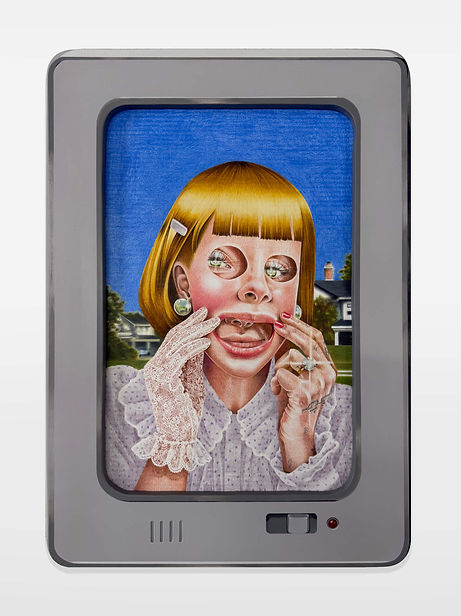
Sharper Image, Taylor Keister.
Fair-Weather Friend inhabits the uneasy space between who we are and who we have learned to be for others. Keister’s figures exist within a world of heightened femininity, suburban fantasy, domestic ritual, and manufactured ideals, where beauty, politeness, obedience, and belonging become forms of performance. Drawing from the expectations embedded in family, religion, community, beauty culture, and small-town mythology, the work considers the ways a person can become shaped by the versions of themselves that others project onto them.
The characters in these works hover between make-believe and reality, willingly participating in rituals that are at once comforting and confining. Their environments feel familiar but slightly misremembered. Domestic objects become talismans, women become dolls, and ordinary gestures are exaggerated into strange acts of fidelity. The theatricality of these worlds reflects the instability of identity itself. The line between pretending and becoming is not always clear.
Fair-Weather Friend considers the cost of maintaining an acceptable version of oneself. To abandon the expectations placed upon us can mean abandoning relationships, histories, and even parts of ourselves that once felt genuine. To remain inside those expectations can mean slowly abandoning the self beneath them. In either direction, something is lost. The work asks whether we can ever fully separate the person we are from the person we have been taught to be, and whether self-preservation sometimes requires becoming a stranger to our own reflection.
The title operates as both accusation and question. A fair-weather friend may be someone who stays only when conditions are pleasant, but the phrase can also turn inward: What happens when we offer ourselves acceptance only under certain conditions? When does pleasing others become a form of self-abandonment, and when does choosing oneself become its own kind of betrayal? Within these contradictions, Keister’s figures oscillate between sincerity and artifice, comfort and unease, devotion and delusion. Their worlds are beautiful because they are constructed, and unsettling because the construction is not entirely separate from reality.
1173 Raritan Rd, Clark, NJ 07066, USA